

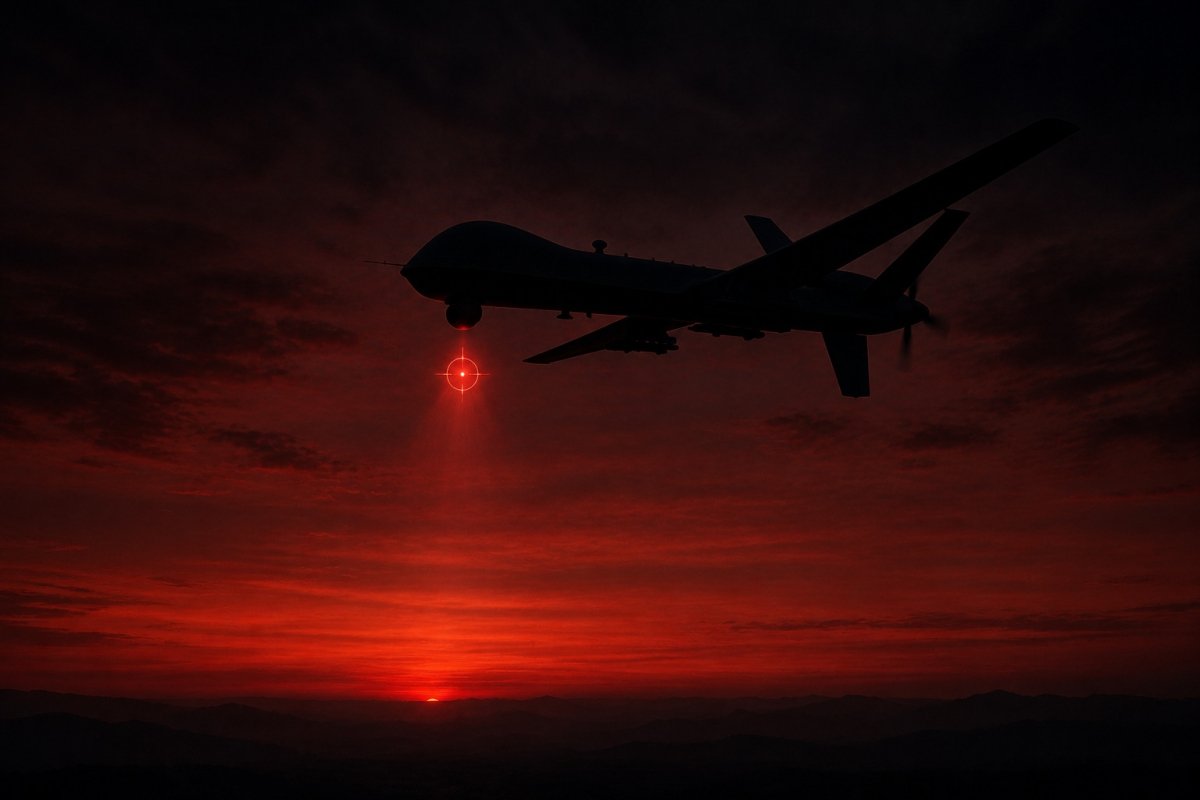
This Is Already Happening, Not a Future Scenario
Discussions of autonomous weapons often get framed as a hypothetical about the future. It isn't. In June 2025, Ukraine's "Operation Spiderweb" used commercial trucks to smuggle drone swarms into Russian territory that identified and struck military targets using onboard machine vision, without real-time human operators guiding each strike. AI-assisted targeting systems have also been reported in use during recent conflicts in Gaza and elsewhere, raising documented legal and humanitarian concerns from international monitors about civilian casualties and the difficulty of assigning accountability when an algorithm, rather than a person, made a targeting decision that resulted in harm.
What Makes These Different From Existing "Smart" Weapons
Precision-guided munitions have existed for decades, but they've traditionally required a human to identify the target and authorise the strike. The newer generation of AI-enabled systems can identify targets using onboard sensors, make engagement decisions without real-time human input, and coordinate as autonomous swarms that adapt to battlefield conditions in real time - removing what researchers call "the weakest link" in the chain from a purely military efficiency standpoint, but also removing the point at which a human could exercise judgement, restraint, or correct a mistake before it happened.
The Core Ethical Argument
Human Rights Watch, the Stop Killer Robots coalition of more than 180 organisations across 65 countries, and the UN Secretary-General himself have all called autonomous weapons capable of lethal decisions without human oversight "morally repugnant" and pushed for an outright ban. Their central argument is that a machine cannot exercise the contextual judgement international humanitarian law requires - genuinely distinguishing a combatant from a civilian in ambiguous, fast-moving, real-world conditions - and that removing meaningful human control from lethal decisions represents a fundamental, unacceptable shift in how the taking of human life is authorised.
The Case Military Powers Make in Response
Major military powers, including the United States and Russia, have consistently resisted a binding ban, arguing that AI-enabled targeting can, in some documented cases, reduce civilian casualties compared to human decision-making under combat stress, by processing more sensor data faster and with fewer of the errors introduced by fear, fatigue, or imperfect information. There is also a harder-edged strategic argument voiced less publicly but widely understood: any nation that unilaterally restricts its own development of these systems risks a meaningful military disadvantage against rivals that don't - a classic arms-race dynamic that makes coordinated, verifiable restraint extremely difficult to achieve even among parties who agree in principle that some limits are needed.
Where the Diplomacy Actually Stands
In December 2024, the UN General Assembly passed a resolution on autonomous weapons by an overwhelming 166 votes in favour, with only a small handful of countries - including the US and Russia - voting against. In November 2025, the UN's First Committee went further, passing a resolution calling for a binding agreement to be negotiated by the 2026 Review Conference. UN Secretary-General António Guterres has explicitly called for a treaty banning fully autonomous lethal weapons - those operating without any human control - to be concluded by the end of 2026, while allowing continued regulation, rather than prohibition, of more limited autonomous systems that retain meaningful human oversight.
Why the Deadline Might Not Be Met
Diplomats and researchers tracking the process describe the current period as a "pre-proliferation window" - the narrow, closing period before autonomous weapons become as widespread and difficult to control as small arms are today. The core obstacle is structural: the primary forum for these negotiations, the Convention on Certain Conventional Weapons, operates by consensus, meaning a small number of major military powers can indefinitely stall an agreement that the overwhelming majority of the world's countries support. If no binding treaty is reached by the 2026 deadline, the pace of autonomous weapons development - already accelerating - is likely to continue outrunning the diplomatic process meant to govern it.