

Where a Prompt Actually Goes
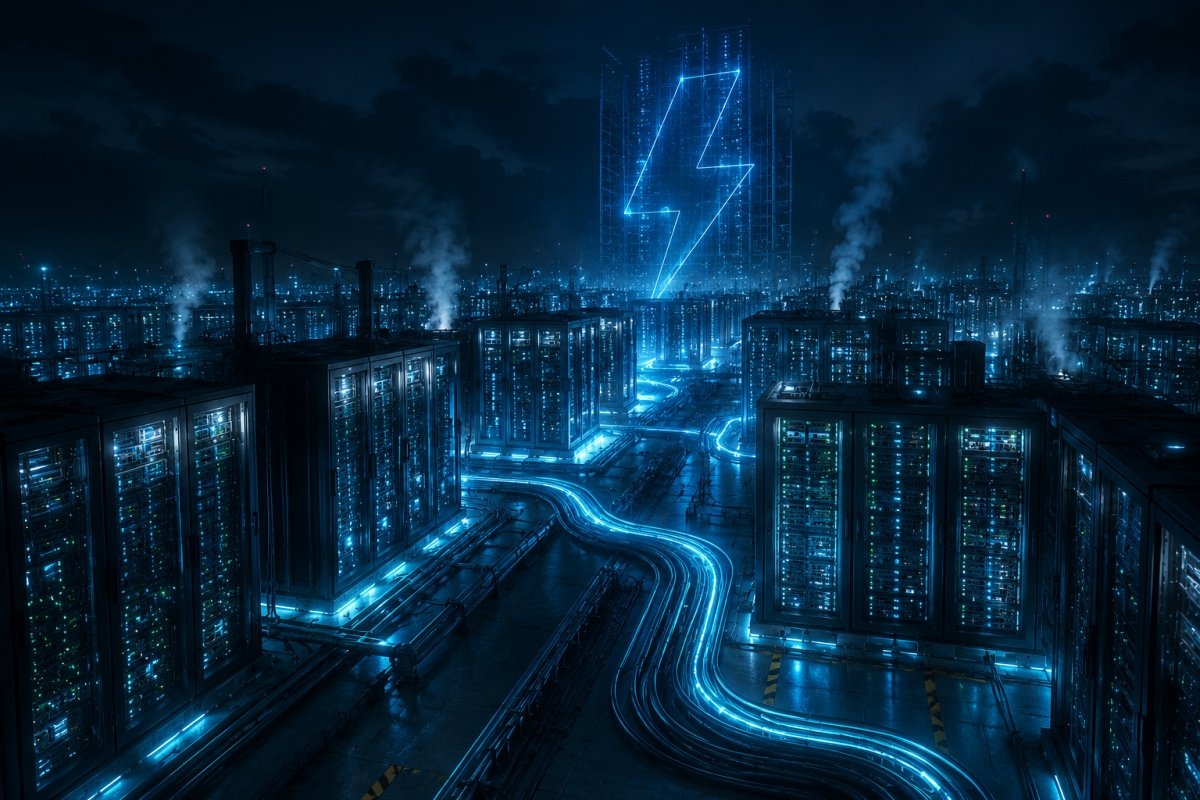
When you type a question into an AI chatbot, the answer doesn't come from your phone or laptop - it comes from a data centre, often hundreds or thousands of miles away, where a cluster of specialised chips processes your request and sends the answer back in a fraction of a second. That round trip feels instantaneous and free. It is neither. According to figures published by the companies themselves, a typical short text query to a major AI chatbot uses somewhere between 0.24 and 0.34 watt-hours of electricity - roughly what it takes to run a low-energy LED bulb for a couple of minutes. On its own, that's genuinely trivial. The problem is scale and complexity: longer, more complex "reasoning" queries or AI agents that use multiple tools in sequence can consume dramatically more, in some documented cases hundreds of times the energy of a simple question.
The Numbers at Global Scale
Individually tiny numbers add up fast when billions of queries happen every day. The International Energy Agency projects that global data centre electricity consumption will roughly double, from around 485 terawatt-hours in 2025 to close to 945-950 terawatt-hours by 2030 - about 3% of all global electricity demand. Electricity use from AI-focused data centres specifically is expected to nearly triple over that same period, growing far faster than data centre demand overall. To put that in perspective, the biggest technology companies collectively spent more than $400 billion on data centre infrastructure in 2025 alone, with spending expected to jump another 75% in 2026 - capital expenditure from just a handful of tech firms that now exceeds global investment in oil and gas production.
It's Not Just Electricity
AI data centres also consume enormous amounts of water, mostly for cooling the racks of processors that generate significant heat running around the clock. Researchers have estimated that every 5 to 50 prompts sent to a major chatbot can use roughly 500 millilitres of water - about one bottle - depending on the cooling method and location of the data centre. In regions already under water stress, this has become a genuine point of local tension, with some communities pushing back against new data centre construction over water and electricity demands that compete directly with residential needs.
The Efficiency Paradox
There is a real silver lining: per-query energy efficiency has been improving rapidly, with some companies reporting the energy cost of an individual text query falling more than thirtyfold within a year, driven by more efficient chips and better software. But this is a case of the classic efficiency paradox - as each individual query gets cheaper to run, more people run more queries, more often, for more complex tasks, and total energy demand keeps climbing anyway. Efficiency gains are being outpaced by growth in usage.
What This Means Going Forward
None of this means AI is uniquely villainous - data centres of all kinds, not just AI ones, have always used significant power, and plenty of other industries have a far larger environmental footprint. But the sheer speed of AI's growth means its energy and water footprint deserves the same scrutiny as any other rapidly scaling industry, especially in regions where new data centres are competing directly with homes and farms for a limited electricity and water supply. As AI becomes part of daily life for billions of people, understanding what a single prompt actually costs - not in money, but in electrons and litres - is a reasonable thing to want to know.